Hair restoration has come a long way in recent years, offering effective solutions for hair loss with natural-looking results. Two of the most common techniques are FUE (Follicular Unit Extraction) and FUT (Follicular Unit Transplantation). While both methods are highly effective, one of the key concerns for patients is scarring.
Understanding how each procedure works, their differences, and the potential for scarring can help you make an informed decision about which hair transplant method is right for you.
Understanding the FUE Method
FUE is a minimally invasive hair transplant technique where individual hair follicles are extracted directly from the donor area — usually the back or sides of the scalp — and transplanted to areas of thinning or baldness.
Advantages of FUE
- Minimal scarring: FUE leaves tiny, dot-like scars that are usually undetectable, even with short haircuts.
- Faster recovery: Because no linear incision is made, healing tends to be quicker.
- Flexible donor areas: FUE allows harvesting from other parts of the body if needed.
Limitations
- Longer procedure: Extracting follicles individually can be time-consuming.
- Cost: FUE is often slightly more expensive than FUT due to the labor-intensive process.
- Graft survival: Requires precise technique to ensure high survival rates of the extracted follicles.
Overall, FUE is often preferred by patients concerned about visible scarring or who like to keep their hair very short.
Understanding the FUT Method
FUT, also known as the strip method, involves removing a thin strip of scalp from the donor area. The strip is then dissected into individual follicular units for transplantation.
Advantages of FUT
- Higher graft yield: FUT can harvest a large number of follicles in a single session, making it ideal for extensive hair restoration.
- Shorter procedure time: Compared to FUE, FUT is often faster for large sessions.
- Potentially lower cost: FUT may be slightly more affordable, especially for larger sessions.
Limitations
- Linear scar: FUT leaves a thin, linear scar at the donor site. While it can be hidden by longer hair, it may be visible with very short haircuts.
- Longer healing time: The incision requires stitches, which can take longer to heal.
- Limited donor flexibility: Only the area from which the strip is removed can be used.
For patients prioritizing a large number of grafts and willing to maintain some hair length, FUT remains an effective choice.
Comparing Scarring: FUE vs FUT
Scarring is often the deciding factor for many hair transplant patients. Here’s how the two methods compare:
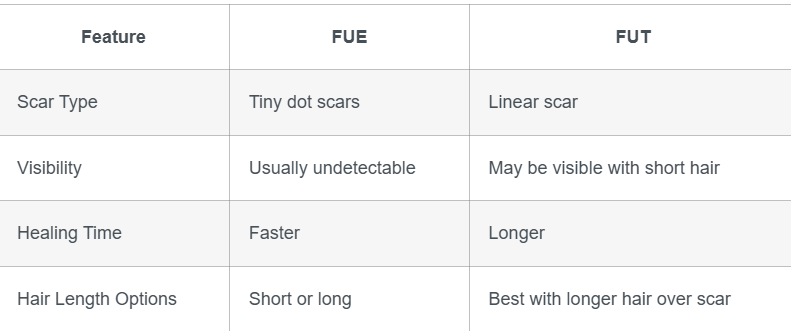
Key takeaway: FUE generally leaves less visible scarring, making it the preferred choice for those who want the option of short hairstyles post-transplant. FUT may leave a linear scar, but it’s usually thin and can be covered with longer hair.
For a detailed discussion on scarring after a hair transplant, check out this guide on scarring after hair transplantation.
Factors That Influence Scarring
Even with FUE or FUT, the visibility of scars can vary based on:
- Skin type: Some patients naturally form more noticeable scars due to genetics.
- Surgeon skill: Experienced surgeons minimize trauma to surrounding tissue, reducing scarring.
- Post-op care: Following instructions for cleaning, avoiding sun exposure, and not picking at scabs promotes optimal healing.
- Number of grafts: Large sessions may slightly increase scarring risk, particularly with FUT.
Choosing a reputable clinic like Hair Restoration Seattle ensures proper technique and care to minimize scarring and promote natural results.
Recovery and Aftercare for Minimal Scarring
Regardless of the method you choose, proper aftercare is crucial:
- Keep the donor area clean and dry as instructed.
- Avoid direct sunlight on the scalp for several weeks.
- Follow medication or topical instructions to reduce inflammation and infection risk.
- Avoid strenuous activity for the first week or as recommended by your surgeon.
For FUE, tiny dot scars heal quickly, and most patients resume normal activities within a few days. FUT requires careful monitoring of the linear incision, which typically heals over 10–14 days.
Choosing the Right Method for You
Your choice between FUE and FUT depends on multiple factors:
- Desired hair length: Short hairstyles favor FUE.
- Extent of hair loss: Large sessions may benefit from FUT.
- Budget considerations: FUT may be slightly more affordable.
- Concern about scarring: FUE generally leaves less visible scarring.
A consultation with a skilled hair restoration specialist is essential to evaluate your hair type, scalp condition, and personal goals. They can provide a recommendation tailored to your needs.
Final Thoughts
Both FUE and FUT are effective hair transplant methods, but they differ in their approach to scarring. FUE is generally gentler on the scalp with tiny, almost invisible dot scars, while FUT leaves a linear scar that may be noticeable with very short hair.
By understanding the pros, cons, and scarring potential of each method, you can make an informed decision that aligns with your goals and lifestyle. Partnering with an experienced clinic like Hair Restoration Seattle ensures the best results, minimal scarring, and a natural, confident outcome.
Whether you prioritize minimal scarring, graft yield, or recovery time, a professional consultation is the first step to achieving the hair restoration results you desire.